On May 10, 2016, the White House announced that President Barack Obama would be the first standing American President to visit Hiroshima.
“In Japan… the President will make an historic visit to Hiroshima with Prime Minister Abe to highlight his continued commitment to pursuing the peace and security of a world without nuclear weapons.”
The announcement left me with two somewhat opposing views. Both of which I lay out below.
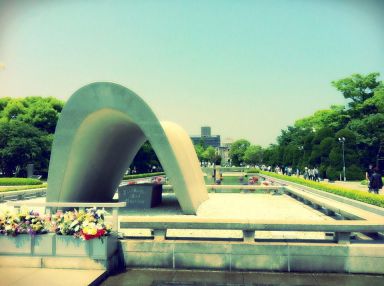
- The Hiroshima Peace Memorial Park when I visited in 2012.
-
Critique:
Obama is an unwitting asset to the malaise of cultural victimhood
I shudder at Obama’s visit to Hiroshima not in the usual way – that is, the view that he is “apologizing” for America. I think that is very far from his mind indeed, and Obama himself is certainly an individual that is governed by an awareness of nuance and historical context.Rather, it is the unwitting way the President is being pulled into a narrative that serves to uphold a cultural indulgence that has plagued Japan for decades.
With sardonic cynicism, I occasionally and chidingly refer to the Hiroshima Peace Memorial Museum as the “Shrine of Victimhood” – a place with more modern cultural relevance and spiritual gravity than even the central Shinto shrines of Ise and Izumo (the former, incidentally, where the G7 will meet this year, and the practical reason of Obama’s visit).
Few things embody Japanese virtues more than a reverence for being a “victim” — built into the minds of countless young Japanese – who are haplessly lead through the museum without a deeper awareness of the gravitas and context of why the Pacific war was fought. Whether it be from war (Hiroshima), economics (the 1990 bubble burst), nature (earthquakes, tsunamis, typhoons), corporate failures (Toyota, Takata, and Olympus scandals), cultural relativity (whaling), international politics (North Korea, South Korea, China), demographics (severe population graying, low birthrate), government failure (the “rotating door” of Prime Ministers), urbanization (hopelessly overcrowded infrastructure), language (increasing influence of “foreign” words in common vernacular) – Japan has a cultural and political addiction to indulging in its own victimhood.
This is not to say that Japanese culture is inherently flawed. Far from it. Japan and the Japanese have extraordinary endurance and patience both as a society and as individuals (ask any foreign visitor or resident of Japan). However, the combined weight of so many narratives of being the victim of circumstances lends to a culture that embraces the hopelessness of conditions beyond one’s control. The “shogenai spirit” – “it cannot be helped”.
Hiroshima, and the Hiroshima Peace Memorial Museum that draws throngs of visitors, is the most holy site to this narrative. School groups and children nation-wide are dragged via bus to the museum year after year, day after day, silently waddling their way through the often grotesque and genuinely heartbreaking scenes and imagery of oblivion. The museum itself, in its own defense, makes attempts to contextualize the use of the atomic weapon – or at least to show the development in an objective manner (that is, at least in the carefully-worded English version of the museum guides. Reportedly the Japanese version use much more passive-tense, which is typical of the linguistic tradition). The museum too pursues the noble goal of nuclear disarmament – a narrative that undoubtedly carried greater weight during the heated days of the 1980s Cold War resurgence, and the idealistic times of Soviet Union’s collapse (interestingly, the museum was renovated in 1991).
President Obama is doubtlessly focused on the latter mission of what the museum promotes. However, how his words will be received in Japan and America will be very differently received. Americans, for their part, will pour over every detail – looking for points to score on individual agendas obsessed with historiographical contextualization of the atomic bombing, and with opponents banging fists and making demands that no genuine leader need to ever “apologize” for America (notably, Obama will almost certainly do neither). For the Japanese – enraptured with a culture that venerates personal and societal victimhood, the visit will bring legitimacy to the narrative that Japan worthy not of our admiration, our courage, nor of our veneration — but of our pity — all while the solutions to the ills that plague the nation, endemic to the culture that rebuilt the nation in the years following the war (and indeed, the bombing) will be overlooked to curry favor as the world’s most hapless nation.
-
Applause:
Old hatreds need not linger — and we can all learn from this
Continuing on the well-established meme that “anything regarding Asia-Pacific directly or indirectly relates to China”, it is worthy of note the ramifications of Obama’s planned visit not only in the context of geopolitics, but narratives of discarding historical hatreds in favor of the potentials resonant in international friendship.
China regularly harps on Japan for what is referred to in general as “historical grievances”, referring to the brutalization of the Chinese populace under Japanese colonial and wartime rule. Indeed, the Chinese national anthem refers directly to resistance against the Japanese, with the entire origin story of the Chinese Communist Party and modern Chinese experience related to the defeat of the villainous Japanese. Korea too, both North and South, derive enormous cultural capital from vilifying Japan.
To this end, there is a context to Obama’s visit that is unspoken, but every bit as powerful and necessary as the message of nuclear disarmament: that historical woes can — and should — be overcome.
This narrative goes far beyond merely the Chinese-Japanese hatreds too. Imagine the degree of hatred of an enemy one must possess to sacrifice one’s life to kill even just one of the hated “other”. Indeed, this was the official policy not only of the well-known kamikaze squadrons, but was in fact a tactical reflection of Japanese military codus – that it is better to kill yourself and take out the hated enemy with you than to subject oneself to the shame of surrender and imprisonment.
Imagine too, the severity of hatred that must pervade your mind and culture to knowingly inflict nuclear annihilation upon an enemy. A hatred so powerful that, not satisfied to merely destroy the enemy under strategic bombing of industrial centers and the capacity to fight, one conceives and develops a weapon so terrifyingly powerful that its use en-mass can very literally inflict the complete destruction of entire populations, nations, and indeed the entire world should one see it fit to do so.
Such was the degree of hatred between Japan and the United States, and the certitude toward which we pursued the conflict with each other. The Japanese, utterly convinced that a spiritual fervor pursued upon a national scale, to the degree that individuals would passionately sacrifice their bodies in pursuit of destruction, could overcome an enemy as overwhelmingly powerful as the United States. The United States too, passionately inflamed by hatred, invoked the full power of science and innovation endemic to its populace, could devise a weapon so horrifically powerful as a nuclear bomb, and then actually used it. Hiroshima, and Nagasaki to follow, were the result – with the horrific bloodshed finally coming to end shortly thereafter.
With the war ended, what of the hatred? Did it linger? Did we carry it with us on for generations? Did we predicate our societies, our religions, or our futures upon the preservation of these hatreds?
No. We didn’t. We cast aside the hatred and even became, unwittingly enough, the closest of friends. And such is the benefit of Obama’s visit to Hiroshima — to commemorate this narrative of almost reconciliation at a historical site – and modern time — of extraordinary hatred.
We live in a world were hatreds of such degrees apparently overwhelm us. Hatreds between cultures and religions – with followers every bit as convinced and certain of their glorious postmortem destinies today as they were in the Pacific war – consume our geopolitical and security concerns at every border crossing and dominate our news cycle. While Americans banter over the morality and historical context of the bombing, and while the Japanese continue to wallow in their perceived destiny of tragedy, a retelling of the arc — from hatred to friendship – is a tale worthy of visitation.
 外国スタン
外国スタン 